


India’s factories are increasingly powered by migrant workers travelling for part or all of the year to take low-wage jobs to supplement declining farm incomes in the country’s least developed and poorest states. Numbering at least 100 million, this workforce faces myriad challenges in securing their workplace entitlements. The poor enforcement of employment law is compounded by the difficulties of being an out-of-state migrant, low awareness of what rights apply and how to secure them, and convoluted and un-transparent procedures. India’s digital inclusion and universal ID have thus far not addressed these issues, with grave consequences for working and living standards of these people.
Gram Vaani’s Saajha Manch (“everyone’s platform”) uses voice-based IVR technology to build engagement of these populations in entitlements and governance. The platform focuses primarily on workers in the industrial areas of Delhi and the National Capital Region.
What life is like for many of India’s migrant workers:
Employment itself is hard to come by and highly uncertain from day to day and both men and women workers in the capital region are facing joblessness.
Earnings reduce with working hours and lower wage rates. Migrants who had always depended on ‘overtime’ payments to save from wages struggle to get by and face uncertain payments even for the work they can find. While women who had earlier focused on child care are pulled into the search for work, other workers hedge their bets by shifting from registered to unregistered workshops who pay piece rates fortnightly.
As employers tighten their belts, relations with workers deteriorate as workers-on-demand are being dismissed without notice and work contracts are revoked in an ad hoc manner. Worker bargaining power appears to be reducing and the situation is exacerbated by the inaccessibility of Provident Fund (PF) and labour officials in the context of COVID-19. Scope remains for workers to take local collective action to stand up to the employers, but such action requires awareness, courage and initiative to coordinate.
Insurance cover from the statutory Employee State Insurance Corporation and an option to draw down savings from the PF, should have provided workers some protection during this period of crisis. But in spite of relaxing eligibility and procedures for both schemes, it is clear that migrants have faced too many & high barriers in their efforts to avail them. While 16% of all recent queries on Gram Vaani’s migrant platform have requested help with PF withdrawals, data shared by our ESI partner Safe in India reveal just over a quarter of insurance card holders meet the eligibility criteria of the unemployment insurance. Men and women workers respond to this uncertainty by requesting exit from the PF scheme which cuts their wages by 12%.
Living conditions have further deteriorated as migrants facing already weak municipal services in the zones of exception where they dwell, face the triple whammy of:- flooding/ drain overflow and the associated risk of vector-born disease; neglected waste, sanitation and transport services on account of the unavailability of timely support; and poorly functional protection provided by government hospitals. Migrants also have had to face and contend with violence and theft, endemic to these low-income high-churn neighborhoods.
How Saajha Manch (SM) helps: Operating through IVR on simple mobile handsets, Saajha Manch provides workers useful information on accessing their entitlements and an easy means to share local news and experience. Saajha Manch is accessed by making a missed call to a unique phone number and receiving the call-back, listening to a pre-recorded playlist and following simple instructions to navigate and record one’s own voice. Listeners can also volunteer to answer survey questions by selecting responses by pressing digits in response to multiple choice questions. Saajha Manch content is also accessible on the Mobile Vaani app.
In response to the various issues outlined above, Saajha Manch offers the following services:
1. Sharing accurate and detailed information on government entitlements, helplines and facilitation services, which users often find difficult to get in one place or know how to access
2. Record questions from listeners with the support of a network of experts, ranging from lawyers to activists to advisers and officials, and then sharing the recorded question with the user who posted it as well as publishing it on the platform for all listeners
3. Offline support for grievance redressal, with support from local NGOs and unions, which helps us take cases to court and see them through to resolution, while also ensuring job safety of the individual worker – who may lose their job if known to have complained
4. Building links with local bureaucrats and elected officials to strengthen accountability, especially on civic issues such as poor living conditions for migrant workers
Choosing the right technology to reach workers:
Smart phones are widely used among younger migrants while older ones tend to depend on button phones, so our services are available both on our Mobile Vaani app and the regular IVR.
Far from becoming obsolete, the pre-internet IVR technology on which Saajha Manch is primarily built remains relevant. Simple phone handsets and audio medium are preferred by workers due to low literacy in dominant languages (Hindi and English) as well as acceptability to employers who frequently bar workers from carrying smartphones. As anxiety over data protection and employer reprisals increase, simple handsets emerge as preferable for worker protection, insulated from internet and visual surveillance. On the other hand, the IVR provides high quality data on user behaviour (e.g. who hears what for how long, how users navigate and whether they contribute). Such real-time data is used to improve the service but never shared with mobile numbers. Gram Vaani maintains control over moderation to assure quality, relevance and avoid hijack of platforms by the powerful or politically motivated. These factors contribute to the trust built among users which secures platform sustainability and reduces costs over time.
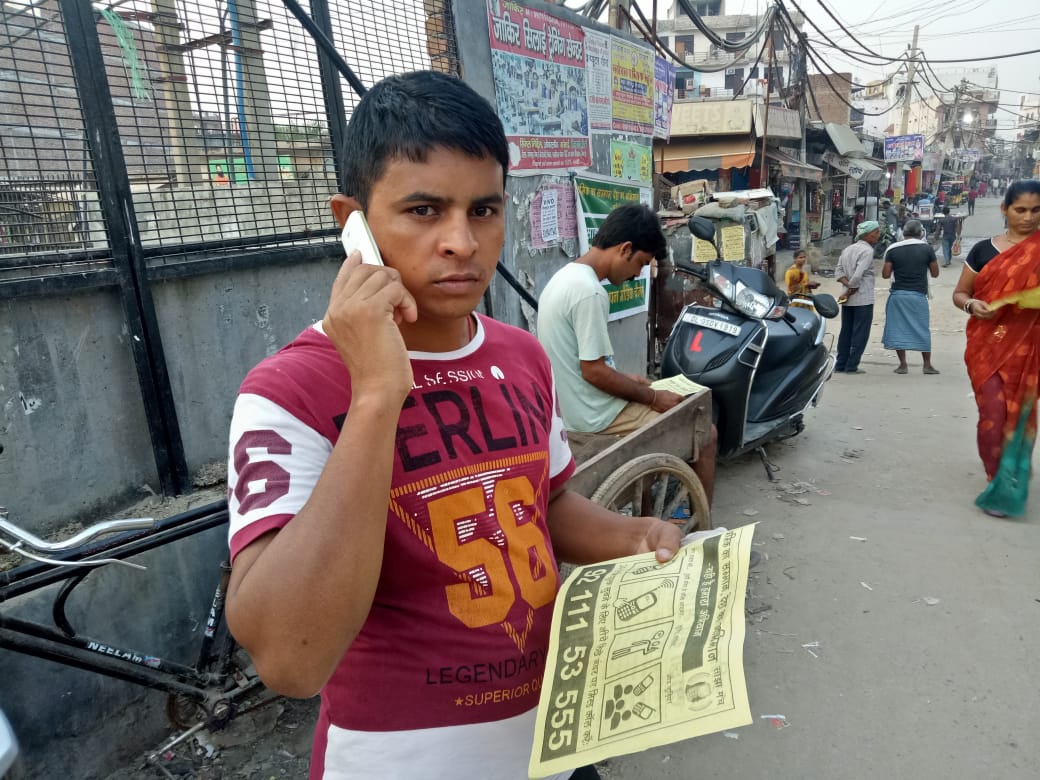
How we enable community participation: In Delhi-NCR, given the constraints of time and public space for low-wage workers, most of Saajha Manch’s mobilising is done on the street. Adjacent to factories, our volunteers and team members distribute pamphlets during lunch, tea and work off time; in residential colonies, they visit local markets, tea stalls and boutique training centres; they set up desks outside government offices and courts where workers come to file complaints.
The power of the platform comes from Saajha Manch volunteer champions, who are migrants themselves, and a mix of factory workers and others, based mostly at destination. Each champion volunteer fosters a ‘club’ of users in the locality, nurturing contributors to post and engage and laying the ground for shared identity and group grievance redressal.
Nand Kishore, for instance, was formerly a tailor, tailor trainer & Ayurveda products direct sales, and lives on the Delhi-Gurgaon border. He has connected with various NGOs and social campaigns (e.g. Anti Corruption Campaign). Tireless mobiliser & news reporter, he joined Saajha Manch because he’s fed up with the injustice all around him.
Ram Karan worked for many years as a skilled tailor, and came on board following Saajha Manch’s help in securing higher compensation at lay-off. A resident of Ayar Nagar just inside the Delhi border, he has been involved in labour rights with other NGOs/ unions and feels the time is right for a community media approach. He is a trained folk singer and has a repertoire of revolutionary and motivational songs!
Besides this, Saajha Manch works with a range of organisations To support curated responses and grievance follow-up offline for its users. For instance, the various chapters of CITU in Gurgaon, Delhi and Noida, partner with Saajha Manch to take occasional cases offline. We have also formalised partnerships with several NGOs with a rights perspective, for different urban-industrial regions. Safe in India (https://www.safeinindia.org/) focuses on ESI health insurance while Nari Shakti Manch focuses on women worker welfare, both in Gurgaon. We have one consultant lawyer practicing in Gurgaon and other district courts to help with legal aid, and request occasional contributions from probono lawyer collectives, including the Human Rights Law Network and Nazdeek.
Our volunteers, users’ opinions, and expert counsel help us build build locally relevant actionable information, as well as offer information and referrals to local parties who can help workers with their issues. Along with this practical assistance, building local voice (news, testimony, opinion) seeds collective identity among workers.
Outcomes we’ve contributed to: Saajha Manch’s listeners come from diverse occupations and livelihoods. A quick listener survey conducted in February 2020 revealed that, of 678 respondents, a third were in garment and other factory work, while a further 23% were currently out of such work. Another 14% were self-employed and, interestingly, 18% informed us they were students. The listener base now totals close to 10,000, of whom 4,000 or so call at least once in any month.
Here are issues we have helped resolve in recent times:
Drinking water in Maruti plant vicinity
At the end of June 2019 in the height of summer in the capital, SM volunteer Raj posted a contribution on behalf of workers of Maruti and other companies that the Maruti plant’s general access water cooler was continuously out of order (http://voice.gramvaani.org/vapp/mnews/1129/show/detail/1809385/). The audio was then forwarded to the Maruti responsible person as well as the sarpanch of the area, and, within two weeks, the plant was up and running again, to the benefitted of some 100 workers. http://voice.gramvaani.org/vapp/mnews/1129/show/detail/2071035/.
Payment of wages
In mid June 2019, SM’s volunteer champion Manohar Lal Kashyap filed a complaint on behalf of workers located at Unit 72, Bahadurgarh Industrial Area, Sector 17, that wages were not being paid on time. This adds to difficulties already experienced by low wages (even below the legal minimum) and is especially an issue when workers request emergency leave (due to a crisis back home, for example) and the company refuses to release their payment:- http://voice.gramvaani.org/vapp/mnews/1129/show/detail/1799344/. Manohar forwarded this news to the Deputy Labour Commissioner as well as company management, after which the labour department verified the case with workers and then issued a common notice to all the companies to give wages by the 7th of each month, according to law. Manohar estimates that 350 workers benefitted from this, by early July 2019 (http://voice.gramvaani.org/vapp/mnews/1129/show/detail/2071132/).
Illegal termination
SM’s champion Raj recorded on behalf of Prem, in September 2019 that he and 60 other workers had been fired with no notice from a company in Gurgaon Manesar’s IMT. Within the month, SM provided a verbal response to guide the workers as to their rights in a situation of unfair dismissal and for the need to prove that they had worked for the company and for how long (http://voice.gramvaani.org/vapp/mnews/1129/show/detail/1856948/). Then, the SM team contacted the workers to ask if they wished to file a case and when they agreed, SM referred them to the Gurgaon branch of CITU, who guided the workers to register a case against the company. The company then called the CITU and workers for a negotiation, which ended, by December 2019, with 32 workers being awarded three months compensation for unfair dismissal, according to law.
Our efforts during the COVID-19 lockdown: When, on 24 March 2020, India’s internal migrants learned that they were henceforth prevented from both earning and travelling home, Saajha Manch was inundated with distress reports and calls, forcing us to repurpose, from our regular focus on rights-at-work, to respond to the looming crisis. By the third week in April, it had become common to receive more than 100 SOS calls in a day. To improve efficiency to cope with numbers, Gram Vaani created an SOS channel. By pressing 0, workers transferred to a question which asked them to select their location from a list of eight, across the three states of Haryana, Tamil Nadu and Gujarat.
Of the over 3,000 unique callers fielded by Saajha Manch between 26 March and 31 May, together with our partners (Gurugram Nagrik Ekta Manch, Feeding India and Ideal Youth for Revolutionary Changes) we were able to respond to 1,590 requests. Other than on-the-ground assistance to relief partners, we leveraged the IVR platform as a way by which SOS calls were registered and allocated, and through which beneficiaries could be verified by phone and in person on receipt of the benefit. Read a detailed report of our efforts during the lockdown here.